Dr. Shing-Chi Leung, SUNY Poly Student Publish Research on Quantum Simulators
Published:
Tuesday, September 22, 2026 - 09:23
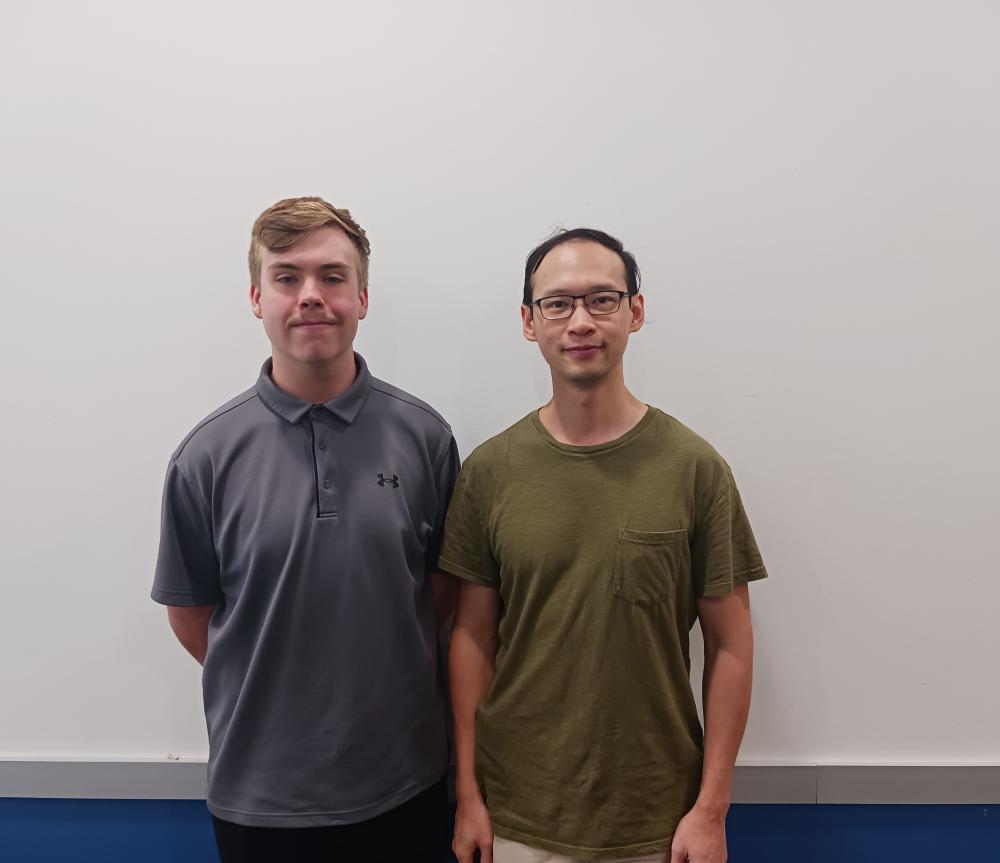
Dr. Shing-Chi Leung, Assistant Professor of Physics at SUNY Polytechnic Institute, published the article “STEM Project Design: Blending Quantum and Computational Physics with Tic-Tac-Toe” in Physics Education. The article is co-authored with student Quintin Weigand, a senior majoring in Computer Science.
The article is based on a student project completed through the Summer Undergraduate Research Program (SURP) in 2025, a 10-week student research internship program. Participating students work with faculty mentors and receive research and communication training. At the end of the program, students present their findings during a poster presentation that is open to the public.
The team reports on the design of a quantum rule-based simulator known as Quantum Tic-Tac-Toe. The simulator was originally designed to facilitate the learning of abstract concepts in quantum mechanics without the use of matrix algebra in a game-like environment. The simulator has rules similar to classical Tic-Tac-Toe, yet it embeds phenomena from quantum mechanics, such as wavefunction collapse, quantum entanglement and quantum superposition. These concepts are also cornerstones of how quantum computers operate.
The crucial difference is that in every step, each player can place more than one mark on the board, mimicking the fact that each player is playing multiple “games” based on the superposition of past moves. This setting substantially increases the number of possible configurations the simulation can achieve. It could contain as many as 10 billion configurations, in contrast to fewer than 400,000 configurations in classical Tic-Tac-Toe. Therefore, statistically, it is not clear how the game behaves differently from the classical version. Dr. Leung worked with Quintin to develop the simulator, using statistical methods to systematically survey the configurations.
In the article, the team revisited the algorithm and highlighted technical difficulties in how the simulations could be implemented. They also discussed strategies for how Quantum Tic-Tac-Toe can be played in contrast to the classical version. By studying more than 10 million configurations, they found convergent behavior in how the game can evolve and developed numerical benchmarks for other instructors’ reference. They also explored new strategies players can use to improve their chances of winning the game.
Dr. Leung commented, “I am glad that this project is an elaborate example of a multidisciplinary project. It combines software engineering in algorithm design to address an interesting problem that cleverly mimics quantum systems. The fact that Quintin built a full-stack structure, where we can visualize the simulation, analyze the results and co-author an article, suggests that our students can achieve interesting results as they work toward a research career.”
Quintin also shared his thoughts about the project.
“Visualizing complex topics like quantum interactions in an easily digestible format is a frontier of software engineering. Even with standard software structures, we applied these concepts not just in computer science environments but in computational physics. This shows the many paths one can take in software.”
Dr. Leung shared that he is expanding the project to other quantum computing topics with SURP 2026 students.