Dr. Behrens Publishes Research on Attachment Across Cultures
Published:
Friday, January 16, 2026 - 09:35
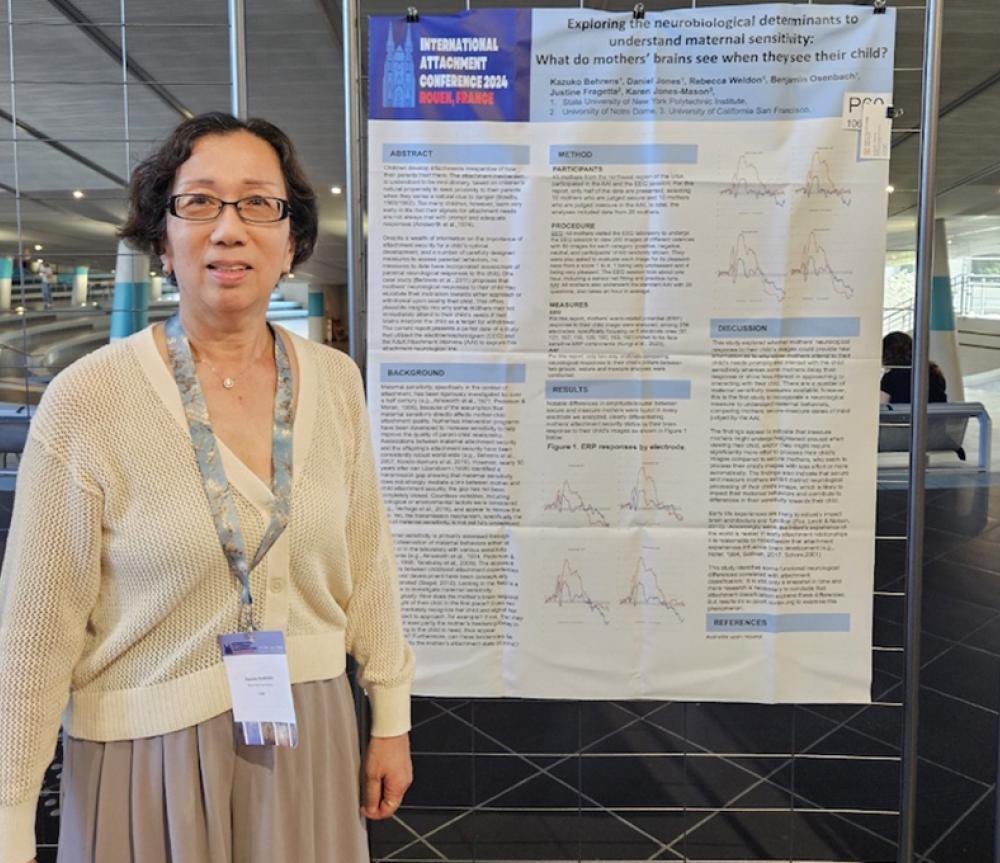
Dr. Kazuko Behrens, Professor and Coordinator of Psychology at SUNY Polytechnic Institute, has published two major peer-reviewed studies that advance the global understanding of human attachment and emotional development. Her newest research appears in Psychoanalytic Inquiry, a leading international journal for mental health professionals, and highlights both the enduring influence and the evolving future of attachment science.
In her article, “The Adult Attachment Interview: Reflections on the Strength and the Limitations of Mary Main’s Measure,” Dr. Behrens examines one of the most widely used tools in attachment research. The study reflects on the Adult Attachment Interview’s scientific impact while also identifying cultural and methodological challenges that arise when the measure is applied beyond Western contexts. Drawing on decades of scholarship and her direct training under attachment legend and pioneer of the Adult Attachment Interview, Mary Main, Dr. Behrens emphasizes the need for culturally informed approaches as attachment research continues to expand worldwide.
Dr. Behrens also co-authored “The First Longitudinal Study of Attachment in Japan: A Partial Replication of Main et al.’s 1985 Work,” which represents the first longitudinal examination of attachment development in Japan, following mother–child pairs from infancy into middle childhood. The findings reveal that while children’s attachment behaviors may change over time, caregivers’ underlying states of mind about attachment strongly predict children’s long-term emotional security—offering critical insight into cross-cultural patterns of development.
Through her work, Dr. Behrens not only honors the legacy of foundational psychological science but also helps shape its future, expanding how researchers, clinicians, and educators understand relationships, culture, and human development around the world.