SUNY Poly Students Showcase Innovation, Ethics and Collaboration in Lockheed Martin Competition
Published:
Wednesday, July 29, 2026 - 12:50
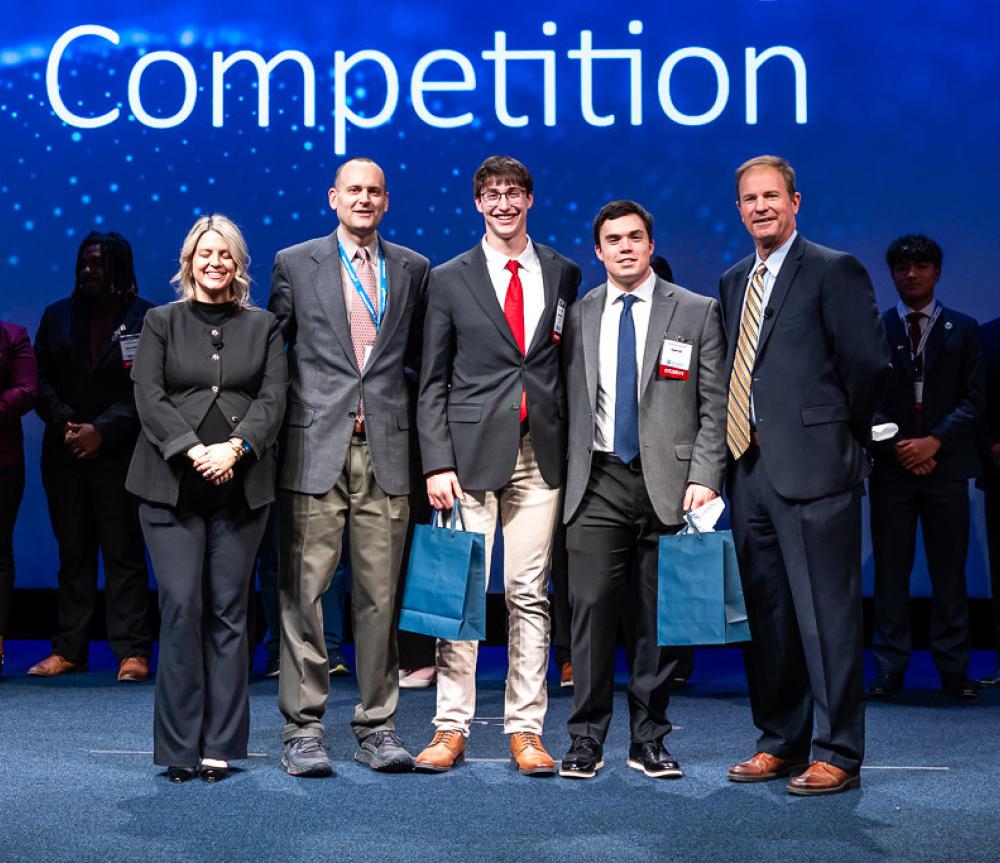
Four SUNY Polytechnic Institute (SUNY Poly) students (Jackson Beckmann, Noa Lolona Haro, Tanner Hill and Spencer Therrien) spent part of the spring semester tackling complex ethical and engineering challenges as part of Lockheed Martin’s Ethics in Engineering Case Competition, demonstrating how interdisciplinary learning, alumni mentorship and donor-supported resources are helping prepare SUNY Poly students for real-world problem solving.
Representing SUNY Poly in the national competition, the students worked together on a month-long challenge centered around command, communication and control (C3) systems and the ethical considerations surrounding defense-related decision making. Competing against students from some of the nation’s top universities, one SUNY Poly team advanced through the preliminary rounds to earn a top-eight finish nationally, outperforming significantly larger schools along the way.
The competition required students to solve both an engineering challenge and an ethics-focused problem while adapting to changing scenarios introduced throughout the event.
“We spent about a month digesting the problem, researching the topic and reaching out to experts,” Jackson explained. “We connected with alumni, professors and professionals in the field to better understand the technical and ethical dimensions of the challenge.”
The students said the experience reinforced the importance of interdisciplinary collaboration and demonstrated how business principles intersect with engineering, technology and national defense.
“Even if you’re not a business major, almost every field involves business to some degree,” Noa said. “Getting involved in Department of Defense-related work showed us how organizations ensure compliance, maintain ethical standards and make critical decisions responsibly.”
The students credited SUNY Poly faculty, alumni and professional mentors for helping them navigate the highly technical engineering components of the competition. They specifically highlighted the guidance of faculty mentor John Szwakob and alumni network connections who provided industry insight and helped the team refine its approach.
The experience also reinforced practical skills that extend far beyond the classroom, including teamwork, communication, time management and coordinating schedules with experts and peers.
“One of the most valuable parts of the competition was the on-your-feet critical thinking and problem solving,” Tanner said. “It was a great way to practice skills that apply across many sectors of business and industries. I'm grateful to the SUNY Poly faculty and staff for providing an unforgettable experience during my time here.”
Donor Support Expands Opportunities for Students
The students emphasized that experiences like the Lockheed Martin competition are made possible through the support of SUNY Poly’s external partners, donors and alumni network.
“We’re incredibly grateful,” Jackson said. “We competed against some of the best schools in the country and did very well because these opportunities were made possible for us. We can put in the work, but without that support we can’t participate in experiences like this.”
Their participation reflects the broader impact of philanthropic investments that help SUNY Poly students engage in experiential learning opportunities, travel to national competitions and connect with professionals across industries.
The students also pointed to the growing impact of the NYSTEC Business Center of Excellence, under the leadership of Executive Director Dr. Jim Staihar, as well as the Center’s AI and fintech learning spaces, which have become important hubs for collaboration, innovation and hands-on learning within the College of Business.
Established with the support of NYSTEC and generous donors like Steve ’06 and Gina ’03 Surace, the NYSTEC Business Center of Excellence has helped expand opportunities for students to engage with emerging technologies, data analytics, artificial intelligence and financial technology applications in practical settings.
Noa described taking a financial analytics course in the AI Trading Room, noting how the advanced learning environment helped bring classroom concepts to life.
“The lab really allowed us to see how these technologies actually work,” he said. “The fintech initiatives and AI-focused projects happening there are pushing students to think differently and explore new ideas.”
The students also highlighted how organizations and donors supporting these initiatives are helping create transformative experiences that go beyond traditional classroom learning.
“You can only learn so much in a classroom,” Noa said. “These outside experiences and initiatives are helping us grow not just as students, but as future professionals.”
Building the Next Generation of Leaders
Although competition rules only allow students to participate once, the team members said they are eager to mentor future SUNY Poly competitors and encourage younger students to take advantage of the university’s extensive professional and alumni networks.
Their advice to future participants is simple: use every resource available.
“We have alumni in so many industries,” Noa said. “Reaching out to experts, professors and people in the network is one of the best ways to prepare. Don’t be afraid to ask for help and maximize every opportunity.”
The Lockheed Martin Ethics in Engineering competition experience reflects SUNY Poly’s continued commitment to experiential learning, interdisciplinary collaboration and preparing students to address the complex ethical and technological challenges shaping the future workforce.