SUNY Poly Students Present at International Physics Conference
Published:
Wednesday, March 25, 2026 - 14:47
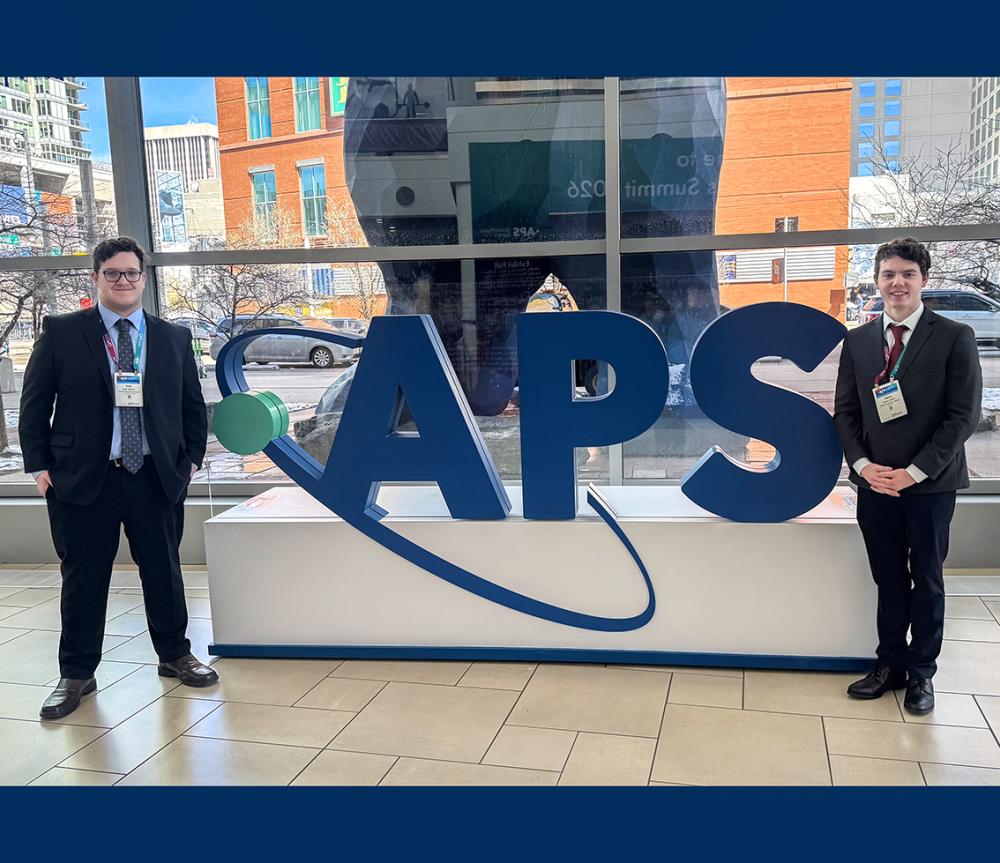
Two SUNY Poly students, Seth Walther (majoring in ECE and Applied Mathematics, with a minor in Physics) and Henry Yerdon (majoring in ECE and Computer Science, with a minor in Physics), delivered oral presentations at the Physics Global Summit (PGS) 2026 in Denver, CO. Organized by the American Physical Society, PGS is the largest physics conference in the world, attracting over 10,000 researchers, students, and industry leaders to share groundbreaking discoveries during the six-day event.
As physics minor students, Seth and Henry conducted their research under the mentorship of Dr. Shing-Chi Leung, assistant professor of physics. Dr. Leung has been working with Seth since summer 2024 and with Henry since spring 2025, focusing on the development of new stellar and supernova models to account for the latest chemical abundance data from the Perseus Cluster, one of the most massive structures in the universe. While the Perseus Cluster exhibits a chemical composition remarkably similar to that of our Sun, current theoretical models fail to explain this pattern. This project aims to identify the underlying physics and develop a new generation of models to bridge this scientific gap.
Applying Dr. Leung’s innovative supernova models, Seth and Henry investigated their impact on galactic chemical evolution. Their findings were showcased in the following presentations:
- Seth Walther: Impact of Primordial Black Hole-Triggered Type Ia Supernova on Fe-group Element Production
- Henry Yerdon: Impact of Aspherical Supernova Explosions on the Galactic Enrichment Process
These talks detailed their analysis of how new supernova models influence the accumulation of metals in the Milky Way since the dawn of the universe.
“I am glad that this year we can support two students representing our group in participating in this exciting research event,” said Dr. Leung. “Their success demonstrates SUNY Poly’s ability to provide high-level research training, enabling our students to meet community-recognized standards. With our recently launched B.S. in Physics, I hope local students interested in astrophysics will see our program as a definitive path toward becoming proficient researchers.”
“I had a really good time being able to explore Denver for the first time because of this experience,” Seth explained. “I attended many interesting talks and learned about new advancements in physics being shared by scholars and researchers alike. Some of the new ways to use AI and LLMs to advance research, rather than replace it, were especially interesting to learn about. You definitely learn more physics at this conference than any class could teach you due to typical time constraints. Giving a talk requires a lot of preparation and dedication. Just like my previous talk at last year’s summit in Anaheim, this experience was no different. I feel that presenting at this level is both a valuable experience and a strong résumé builder. Because of my previous experience, I had fewer nerves and could focus more on delivering a strong presentation of our research and findings. Overall, I am very thankful to have had this experience for the second time—it was definitely well worth the trip!”
“This trip to Denver was a very exciting and fulfilling experience,” added Henry. “It was my first time traveling outside of the state on my own, which made it even more memorable. The conference itself was also a new experience for me, and it wasn’t exactly what I had expected. It was a much more welcoming environment than I anticipated. I expected everyone to be in suits and ties, focused solely on physics, but instead it was more relaxed. People wore less formal clothing, interacted outside the venue over coffee, and discussed topics beyond physics. The attendees cared more about the science than the formality and were eager to share their work, theories, and interests with others. It was fascinating to attend the various talks throughout the week. I learned about many areas of experimental physics that are not typically covered in classroom lectures. It truly broadened my understanding of the field and the many paths physics can take you. I also greatly enjoyed presenting my own work at the conference. The entire process—from conducting the research and learning the background, to obtaining results, preparing the talk, and finally presenting in Denver—was a lot of work, but also incredibly fulfilling. I would recommend any SUNY Poly student with an interest in physics to try research. I am very grateful for the opportunity to travel and attend the APS Global Summit.”
The group plans to finalize these projects through a series of articles to be submitted to The Astrophysical Journal.
Dr. Leung acknowledges support from the National Science Foundation under Grant AST-2316807.