CNIE Summary
The Center for Nature Inspired Engineering (CNIE) is an interdisciplinary research hub established to advance SUNY Poly's strategic vision in Autonomous Advanced Manufacturing. The center brings together faculty, students, and industry partners to explore the understanding of nature inspired principles to guide the design/development of next-generation engineered structures to address challenges in biomedical engineering, flexible electronics, soft robotics, and smart sustainable infrastructures.
The goal of CNIE is to become a self-sustaining, national research center that drives the development and optimization of innovative sustainable engineering solutions inspired by natural materials and structures. The center's mission is to design, manufacture, and characterize next-generation nature-inspired materials and structures by integrating artificial intelligence (AI), mechanistically-based design methodologies, smart manufacturing, and state-of-the-art characterization techniques. Research activities includes state-of-the-art mechanical and materials characterization, 3D- and 4D-printing assisted advanced manufacturing, computational simulation, numerical analysis, and theoretical modeling. In achieving these capabilities, CNIE will support multidisciplinary research across the Colleges of Engineering and Health Sciences at SUNY Poly, as well as collaborations with external academic members from Syracuse University and Stony Brook University, and industrial members from Bristol Myers Squibb (BMS), Collins Aerospace, Indium Co., and Resonetics.
The center's primary focus spans four major thematic areas:
- Biomedical Structures
- Flexible Electronic Materials
- Robotic Materials and Structures
- Sustainable Materials
List of CNIE Members
CNIE includes ten academic members (including one PI, four co-PIs, four collaborators and one center manager), four industrial board members, three graduate assistants listed as the following:
Center Director and PI: Dr. Xinrui (Sarah) Niu, Professor of Mechanical Engineering at SUNY Poly
Co-PIs:
- Dr. Zhao Qin, Assistant Professor of Civil Engineering at Syracuse University
- Dr. Wanliang Shan, Associate Professor of Mechanical Engineering at Syracuse University
- Dr. Lifeng Wang, Associate Professor of Mechanical Engineering at Stony Brook University
- Dr. Yu (Joe) Zhou, Associate Professor of Mechanical Engineering and Collaborator of WINGS at SUNY Poly
Collaborators:
- Dr. William Durgin, Professor of Engineering and Co-PI of CESSAIR at SUNY Poly
- Dr. Joanne Joseph, Professor, Coordinator of Health Sciences, and Director and PI of CHIHE at SUNY Poly
- Dr. Fan Liu, Research Assistant Professor of Mechanical Engineering at SUNY Poly
- Dr. Wole Soboyejo, President, Professor, and Director and PI of GCAMM at SUNY Poly
Center Manager: Dr. Precious Etinosa, Research Scientist at SUNY Poly
Industrial Board Members:
- Dr. Feng Feng, Senior Technical Fellow at Collins Aerospace, Hartford, CT
- Dr. Yusuf Oni, Head of Packaging at Bristol Myers Squibb (BMS), Lawrence Township, NJ
- Dr. Weimin Yin, Principal Metallurgist at Resonetics, New Hartford, NY
- Dr. Hongwen Zhang, Principal Research Metallurgist and R&D Manager at Indium Co., New Hartford, NY
Graduate Assistants:
- Srishwan Beecharaju: 09/2025–present
- Brenda (Xue) Bai: 05/2025–08/2025
- Vandana Katta: 06/2025–08/2025
On-going Research at CNIE
Natural teeth usually consist of multiple layers including enamel, dentin, dentin-enamel-junction (DEJ), and so on. Although small cracks may initiate in the brittle enamel under occlusal loads, most of the cracks are arrested by DEJ and/or dentin, which avoids bulk fracture of teeth and allows teeth to survive millions of cycles of occlusal loads with the existence of small cracks. Inspired by the remarkable fracture and fatigue resistance of natural teeth, many efforts were devoted in the past several decades to the development of bio-inspired dental multilayers which also consist of stiff top layer and durable substrate layers. However, this bio-inspired endeavor encounters long-standing difficulty. Although having a similar structure, the man-made dental multilayers have much lower crack-resistance than natural teeth. The drawback of man-made dental multilayers is due to many reasons. Lacking guidance upon structural design and inadequate information about fracture mechanisms of both natural teeth and man-made dental multilayers are among the most important reasons.
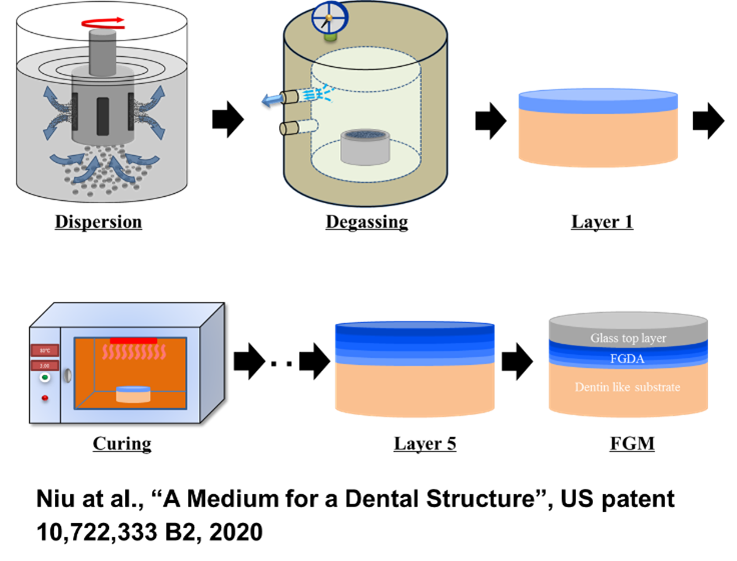
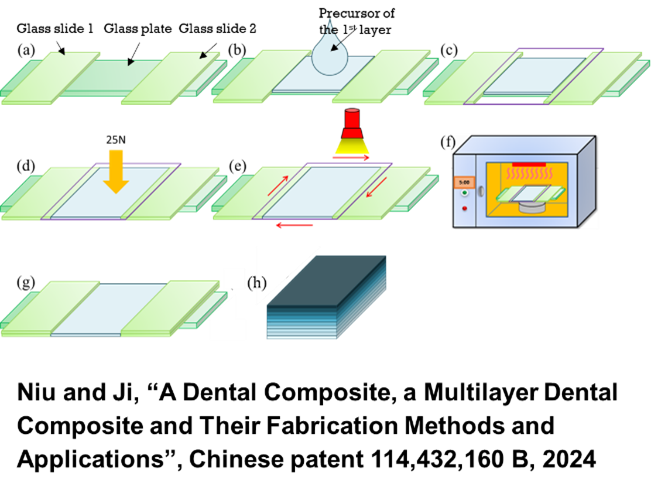
The investigators have worked on this topic since 2009 when Soboyejo, Niu and co-workers invented a bio-inspired functionally graded (BFG) dental adhesive which significantly enhanced the resistance to the crack initiation of dental multilayer under monotonic loading. Recently, Niu and co-workers invented a next generation BFG dental adhesive which significantly enhanced the resistance to the bulk fracture of dental multilayer (Niu et al., 2020; shown in the left figure below) and a multilayered BFG-dental restorative composite (DRC) fabricated by a novel process in (Niu & Ji, 2024; shown in the right figure below).
Currently in CNIE, the investigators are investigating fracture and fatigue mechanism of the newly invented BFG-DRC with both experiment and computational simulation. Architectural design facilitated by Ashby's chart will be conducted to select the optimal architecture which enhances fracture resistance while maintaining overall material composition and feasible behaviors, such as tooth-like rigidity and optical properties, of the current DRC. 3D printing will be adopted in this project to establish a more standardized manufacturing platform. Fracture and fatigue behaviors in water and saline water will be explored. Characterized by the state-of-the-art microscopies, such as SEM, EDX, micro-indentation and AFM and standardized mechanical tests will be carried out.
Smartphone is an indispensable component of people's daily life. To dissipate the heat generated by smartphone components and improve user experience, touchscreen in smartphone is getting larger and thinner, making the touchscreen glass easier to be damaged than before. To tackle this problem, smartphone manufacturers developed chemical and/or physical methods to toughen touchscreen glass. However, these methods often require high temperature and precision machining technology that are expensive and energy consuming. Cost-friendly and energy-saving alternatives are necessary.
Dr. Niu and co-workers invented a bio-inspired adhesive which reduces cracking of touchscreen glass of smartphone. Instead of toughening touchscreen glass, this work reduced stress concentration in touchscreen glass by structurally modifying the adhesive underneath touchscreen glass into a BFG adhesive. FEA suggested that, at the same mechanical load, the newly invented BFG adhesive significantly decreased the maximum stress in touchscreen glass. Experimental results demonstrated that BFG adhesive enhanced the fracture resistance of a reduced smartphone structure. A US patent was granted based on the above work (Niu and Xu, 2021; shown in the figure below). Compared to the conventional methods, the new method is more cost-friendly and energy-saving. The results of this work will not only benefit the fracture resistant design of smartphone but also be extended to other electronic devices with large screen glasses such as tablet, laptop computer, television, and so on.
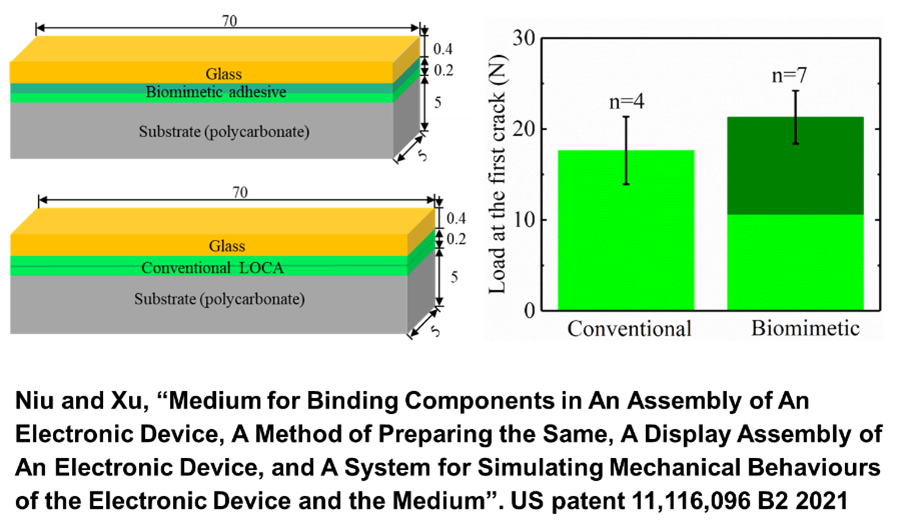
In CNIE, investigators will devote efforts to characterizing mechanical properties of BFG adhesive, seeking an optimal material composition which balances mechanical and optical properties, and developing bulk production manufacturing process.
Storage of liquids in the presence of vapor or gas is difficult in some terrestrial situations and in microgravity activities. For example, while hydrogen is a desirable alternative to hydrocarbon fuels, storage as a liquid is difficult when traditional liquid/vapor tankage is used. Alternative storage of liquid hydrogen in matrices of solid materials or molecules is highly desirable and depends critically on surface tension forming capillary interfaces. Forming an effective hydrogen supply chain would be beneficial in reducing carbon dioxide emissions in transportation and energy production systems. In the microgravity environment, the reorientation of liquid fuels aboard spacecraft is crucial to the restarting of engines or the operation of thrusters. Problems with the Boeing Starship are a good point of reference. Liquid orientation is essential for restarting engines while on orbit. While capillary control baffles have been used, greater reliability is necessary for safe, reliable operation.
Capillarity is employed throughout nature. For example, plants and trees utilize capillary action to raise water from roots to leaves. In the human body, the capillary movement of water throughout the body carries nutrients to cells. Additionally, the transport of oxygen and carbon dioxide in lungs relies on the variation of surface tension to effect transport across membranes. Some adaptations to heat transfer have been developed analogous to sweating. Here, moisture secreted through the skin forms into droplets which evaporate thus transporting heat from the body. This principle has been adopted in heat pipes wherein liquid is transported in fine grooves or filamentous gauzes to move liquid from a cold location to a hot location where evaporation takes place. The vapor then flows back to the cold location where it condensed.
While it is fairly simple to absorb liquid into a matrix through capillary action such as in a towel, napkin, or paper towel, it is much more difficult to subsequently release that liquid. In day-to-day activity, we would simply squeeze the water out. Sponges are a good example. However, in many situations, such mechanical deformation is not practical. Nevertheless, there is a suggestion of a method analogous to squeezing. By containing liquid in a 3D matrix structure that can be manipulated in shape, effective liquid release may be achieved. The research proposed here will investigate structural shapes and deformation movements that effectively release trapped liquid.
This research direction aims to develop nature-inspired strategies for the controlled storage, orientation, and release of liquids in environments where traditional tank systems fail, such as hydrogen storage on earth and propellant handling in microgravity. The center will explore biomimicry of natural examples of capillary transport such as fluid movement in plants, biological membranes, and evaporative heat-transfer systems. Thus, developing 3D matrix structures that use surface-tension-driven interfaces to efficiently contain liquids and enable reliable reorientation without mechanical pumping or deformation. By designing geometries that promote both capillary retention and controlled release, the PI and co-PIs will investigate sustainable solutions to the challenges faced in aerospace systems, hydrogen fuel storage, and other applications where liquid positioning is critical. The center will investigate optimized material architectures, deformation modes, and capillary pathways to create robust, passive liquid-management systems with significant implications for sustainable energy technologies and spaceflight reliability.
This project is about designing underwater adhesives for reliable gripping and easy release with inspirations from nature. Octopus and sea urchins can manipulate objects or attach to surfaces using their soft body parts. It is well known that they use suction as (part of) the mechanism for such underwater adhesion manipulation. This project will use rapid prototyping and solid mechanics modeling to explore bioinspired designs of underwater adhesives made of commonly used elastomers such as Polydimethylsiloxane (PDMS) or vinyl polysiloxane (VPS). 3D printers will be used for fabrication of molds that elastomers are cast into. Adhesion characterization tests of the adhesive samples on a universal tensile machine such as an Instron micro-tester will be conducted, both under dry and underwater conditions. Finite element simulation using commercially available software such as Abaqus will be conducted to elucidate the underlying mechanism for observed enhanced adhesion from bioinspired structures. Experiments and FE modeling will form a feedback loop for optimized bioinspired adhesive design.
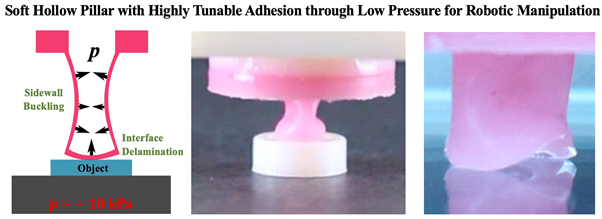
Schematics of Suction Grip and Release (Wanliang Shan)
The United Nations Sustainable Development Goals outline 17 interconnected grand challenges that represent areas where urgent action is required to safeguard the well-being of all people and the planet. Biology is at the heart of many of these goals - from sustainable manufacturing and agriculture to energy, biomedical, pollution treatment, and strategy for climate change. Mycelium, as the vegetative structure of fungi, can rapidly grow into a dense hydrophobic layer to cover the curved or porous substrates under natural environmental conditions. It exhibits fascinating functions (e.g., self-growing, mechanical strength, energy efficiency, environmentally friendly, tunability) at multi-scale levels. Coating with a living self-organizing mycelium layer on diverse engineering materials gives them new surface properties. The technology of the materials, including revealing the hidden gene-structure-function relationship and innovative direct application of this material, is crucial to accelerate the transition to sustainable and circular development. We plan to focus on mycelium-based functional surfaces, which have exhibited efficiency in repelling unwanted materials or energy forms (e.g., hydrophobic, reflection of sunlight, thermal management, mechanical reinforcement), prevent them from damaging the inner materials, and help maintain the performance of the substrate materials over time. We will develop multifunctional coating based on fungal biotechnology. Specifically, we plan to: 1. Characterize the microstructures of mycelium coating on engineering materials surfaces; 2. Develop multiscale physical models to reveal the structure-function relationship of mycelium coating; 3. Integration of mycelium with nano and microparticles for functional reinforcements; 4. Carry out bioinspired design and optimization with machine learning and generative AI to understand how the material structures lead to its material advantages, making the coating suitable for large-scale applications. Our preliminary studies have demonstrated that mycelium coating leads to strong, tough materials with thermal stability and insulation. We found that mycelium can be used to replace plastic foams for sustainable insulation, which is a lightweight barrier against fire, water, noise, and thermal conductivity. We are applying our research technique from molecular modeling to large-scale applications in building and energy. We expect to develop sustainable, functional surfaces for engineering products and civil constructions, which have an advantage over existing technologies that rely on conventional coating materials that are energy-intensive and made of non-degradable plastics.
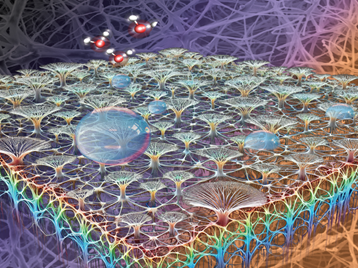
Schematics of Mycelium Film
(Zhao Qin et al. "Mycelium–coir-based composites for sustainable building Insulation", Journal of Materials Chemistry A, 13, 2025)
Combining the advantages of two or more materials, polymeric hybrid formed by dissimilar materials is attracting more research attention for applications such as flexible electronics, regenerative tissues, soft robotics, and so on. In a hybrid, dissimilar polymeric components are often connected by adhesives. Yet, adhesives are often vulnerable in resisting interfacial fracture and bulk fracture. The latter is often induced by and/or associated with the former.
With the help of 3D-printing technique, Dr. Niu and co-workers invented a new method to connect dissimilar polymeric materials via a 3D knot-like interphase in which two dissimilar polymers entangled with each other. Examined by peeling test, a hydrogel-elastomer hybrid connected by 3D-printed interphase showed significantly higher structural integrity, which was defined as separation energy, than the conventional hybrid connected by adhesive. A US patent (Niu et al., 2021; shown in the figure below) was granted based on this work.
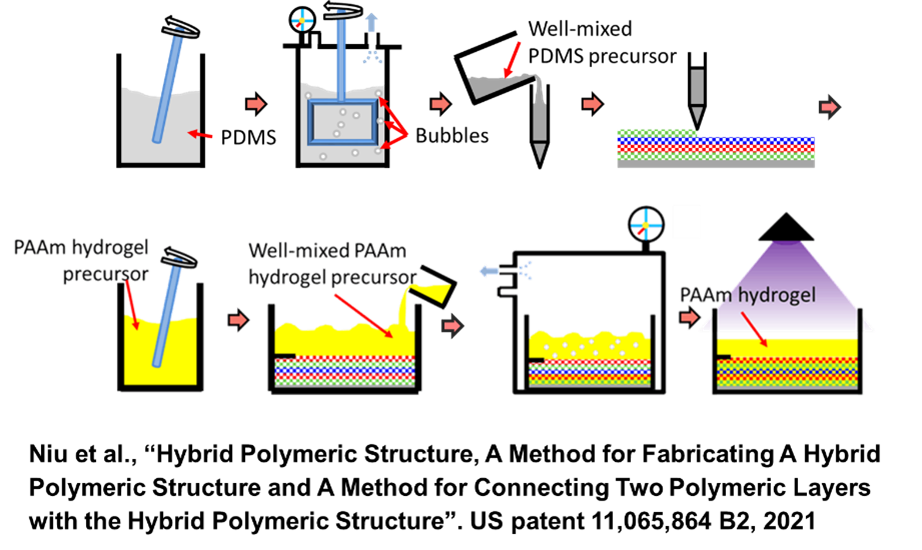
Once the idea is demonstrated feasible. It is important to gain in-depth understanding on the deformation and separation mechanisms of the 3D knot-like interphase and its quantitative impact on enhancing separation energy of a hybrid. Since the 3D knot-like interphase has a complex structure, this task is comprehensive. CNIE investigators will conduct hierarchical finite element analysis (FEA) to optimize the architecture of knot-like physical interphase to maximize separation resistance of the hybrid while maintaining structural flexibility. The optimal design achieved through FEA will be fabricated and examined by versatile mechanical tests, not limited to peeling tests.
Research Professionals
Dr. Xinrui (Sarah) Niu (Center Director and PI)
Professor of Mechanical Engineering at SUNY Poly
niux@sunypoly.edu
Dr. Xinrui (Sarah) Niu is a Professor of Mechanical Engineering at the State University of New York Polytechnic Institute (SUNY Poly). Her research focuses on bioinspired materials for wellness, energy-saving and sustainable environment. She studies mechanical and physical behaviors of bioinspired materials and structures, smart manufacturing, non-linear elastic behavior of solids, polymer-based composites, and so on. Dr. Niu has published over 40 SCI-listed journal articles, 4 book chapters, 4 US patents and 1 international patent and delivered two dozen invited talks and more than 70 presentations in the leading academic conferences and world-renowned universities.
Before joining SUNY Poly in January 2025, she was an Associate Professor at the City University of Hong Kong. Before that, she briefly worked as an R&D engineer at MicroPort Medical Co. for the design of durable biodegradable stents and led the company-wide finite element analysis platform which supported the design of various endovascular stenting products. Dr. Niu received a B.E. degree in Engineering Mechanics and an M.E. degree in Solid Mechanics from Tsinghua University, an M.S. degree in Mechanical Engineering from the University of Notre Dame and a Ph.D. degree in Mechanical Engineering from Princeton University.
Relevant Publications:
- Ding, Y., Yuan, W.K., Liang, X., Niu, X. and Wang, G.F., "Relaxation and creep responses of biological materials under spherical indentation considering surface tension". Mechanics of Materials, 202 105257 (16 pages) (2025); DOI: 10.1016/j.mechmat.2025.105257
- Ding, Y., Yuan, W. K., Liang, X. M., Wang, G. F. and Niu, X., "Identification of Plastic Properties Through Spherical Indentation". Advanced Engineering Materials, 24 2200379 (2022); DOI: 10.1002/adem.202200379
- Zhan, Y., Pan, Y., Chen, B., Lu, J., Zhong, Z. and Niu, X., "Strain Rate Dependent Hyperelastic Stress-stretch Behavior of a Silica Nanoparticle Reinforced Poly (ethylene glycol) diacrylate Nanocomposite Hydrogel". Journal of the Mechanical Behavior of Biomedical Materials, 75 236-243 (2017); DOI: 10.1016/j.jmbbm.2017.07.029
- Yao, Z., Zhang, H., Hu, Y., Bian, J.J., Wang, G.F., Lu, J. and Niu, X., "Ultrasound Driven Aggregation - A Novel Method to Assemble Ceramic Nanoparticles". Extreme Mechanics Letters, 7 71-77 (2016); DOI: 10.1016/j.eml.2016.03.015
- Niu, X., Rahbar, N., Farias, S. and Soboyejo, W.O., "Bio-inspired Design of Dental Multilayers: Experiments and Model". Journal of the Mechanical Behavior of Biomedical Materials, 2 596-602 (2009); DOI: 10.1016/j.jmbbm.2008.10.009
Dr. Zhao Qin (co-PI)
Assistant Professor of Civil Engineering at Syracuse University
zqin02@syr.edu
Zhao Qin is an Assistant Professor at Syracuse University whose research integrates mechanics of bioinspired and sustainable materials, multiscale modeling, and AI-assisted materials design. His group studies living and bioinspired composites, interfacial mechanics, mycelium-based materials, bamboo and bone-inspired architectures, and physics-aware multimodal AI frameworks. He has published over 150 papers (H-index 54), received the NSF CAREER Award (2022), and delivered invited seminars and lectures in Europe and Asian countries.
Relevant Publications:
- The Structure‐Mechanics Relationship of Bamboo‐Epidermis and Inspired Composite Design by Artificial Intelligence Z Qin, AP Destree Advanced Materials, 2414970, 2025
- Animal-skin-pattern-inspired multifunctional composites by generative AI M Masrouri, AV Jadhav, Z Qin Cell Reports Physical Science 6 (2), 2025
- Mycelium–coir-based composites for sustainable building insulation G De, L Yang, J Lee, YH Wu, Z Tian, Z Qin Journal of Materials Chemistry A 13 (14), 9694-9707, 2025
- The mechanics and design of a lightweight three-dimensional graphene assembly Z Qin, GS Jung, MJ Kang, MJ Buehler Science advances 3 (1), e1601536, 2017
- Molecular Dynamics Simulation of the alpha-Helix to beta-Sheet Transition in Coiled Protein Filaments: Evidence for a Critical Filament Length Scale Z Qin, MJ Buehler Physical Review Letters 104 (19), 198304, 2010
Dr. Wanliang Shan (co-PI)
Associate Professor of Mechanical Engineering at Syracuse University
washan@syr.edu
Dr. Shan is an associate professor at the Department of Mechanical and Aerospace Engineering (MAE) at Syracuse University (SU). Before that, he was an assistant professor at SU and at University of Nevada, Reno (UNR), each for five years. He obtained his Ph.D. degree from Princeton University in 2012 and his B.E. degree in Thermal Science and Energy Engineering from University of Science and Technology of China in 2006. He also completed a two-year postdoctoral training at Carnegie Mellon University, before joining UNR as assistant professor in 2014. His research focuses on interdisciplinary research in Smart, Hybrid, Active and Nature-inspired Materials, Mechanics, and Machines. Fundamental insights from solid mechanics, materials engineering, machine learning, and thermal science are emphasized for the design and fabrication of soft multifunctional materials and high-performance robotic mechanisms, which impact critical application domains such as soft robotics and biomedical devices. His research, innovation and educational efforts have been funded by SU, UNR, NSF, and NASA. Dr. Shan is a recipient of the prestigious NSF Career Award (2023). He has been serving as an associate editor on soft robotics for IEEE Robotics and Automation Letters (RA-L) since 2022. He has been serving as CEO of a spin-off startup TunaBotics that commercializes the tunable adhesion technologies invented by his group since 2024.
Relevant Publications:
- C. Zhao, Y. Tang, K.T. Wan, W.L. Shan*, Soft Shell Grippers with Highly Tunable Dry Adhesion through Low Negative Pressure for Universal Manipulation; Advanced Functional Materials, 202504871, 2025.
- C. Zhao, K.T. Wan*, W.L. Shan*, Progressive Adhesion Mechanics of Elastomeric Shells against a Rigid Substrate: from Thin to Thick, Extreme Mechanics Letters, 68:102140, 2024.
- G. Wan, W.L. Shan*, Pneumatically Tunable Adherence of Elastomeric Soft Hollow Pillars with Non-Circular Contact, International Journal of Solids and Structures, 294:112736, 2024.
- G. Wan, Y. Tang, K.T. Turner, T. Zhang*, W.L. Shan*, Tunable Dry Adhesion of Soft Hollow Pillars through Sidewall Buckling under Low Pressure, Advanced Functional Materials, 33(2):2209905, 2023.
Dr. Lifeng Wang (co-PI)
Associate Professor of Mechanical Engineering at Stony Brook University
lifeng.wang@stonybrook.edu
Prof. Lifeng Wang is an Associate Professor in the Department of Mechanical Engineering at Stony Brook University. Prior to joining Stony Brook, he was a Postdoctoral Associate at the Massachusetts Institute of Technology (MIT), working with Professor Mary C. Boyce. He received his B.E. (2001) and Ph.D. (2006) degrees from Tsinghua University, with a specialization in Solid Mechanics.
Prof. Wang is a recipient of the National Excellent Doctoral Dissertation Award of P.R. China (2008) and the Natural Science Award from the Ministry of Education of China (2009). His research has been featured by major media outlets, including MIT Homepage Today's Spotlight, MIT News, NBC News, Nature News, Materials Views, and Phys.org. Since 2020, he has been consistently named to the World's Top 2% of Scientists List by Stanford University.
Prof. Wang's research interests span materials modeling, computational mechanics, materials testing, characterization, and fabrication. He specializes in the design and characterization of composite materials and mechanical metamaterials, with expertise in rapid prototyping and 3D printing. His work also focuses on the mechanical behavior of polymer fiber networks, micro-structured and nanocomposite materials, as well as the mechanics and design of biological and bio-inspired materials. He has published more than 70 peer-reviewed journal articles, with an h-index of 48 and over 8,000 citations.
Relevant Publications:
- F. Liu, X. H. Jiang, Z. Chen, and L. F. Wang, "Mechanical Design Principles of Avian Eggshells for Survivability", Acta Biomaterialia 178, 233 (2024)
- F. Liu, T. T. Li, X. H. Jiang, Z. A. Jia, Z. P. Xu, and L. F. Wang, "The Effect of Material Mixing on Interfacial Stiffness and Strength of Multi-material Additive Manufacturing", Additive Manufacturing 36, 101502 (2020)
- Z. A. Jia and L. F. Wang, "3D Printing of Biomimetic Composites with Improved Fracture Toughness", Acta Materialia 173, 61-73 (2019)
- Z. A. Jia, Y. Yu, S. Y. Hou, and L. F. Wang, "Biomimetic Architected Materials with Improved Dynamic Performance", Journal of the Mechanics and Physics of Solids 125, 178-197 (2019)
- L. F. Wang, J. Lau, E. L. Thomas, and M. C. Boyce, "Co-Continuous Composite Materials for Stiffness, Strength and Energy Dissipation", Advanced Materials 23, 1524-1529 (2011)
Dr. Yu Zhou (co-PI)
Associate Professor of Mechanical Engineering and Collaborator of WINGS at SUNY Poly
zhouy2@sunypoly.edu
Yu Zhou received his PhD in Mechanical Engineering from The Johns Hopkins University in 2004. He is currently an Associate Professor in Mechanical Engineering at SUNY Polytechnic Institute. His main research area is robotics. His research interests include modeling, motion planning, and motion control of robots and multi-robot systems and extend to data analysis, signal processing, detection and recognition, using techniques of machine learning, optimization, and control, for applications including but not limited by manufacturing, healthcare, agriculture, and services.
Relevant Publications:
- Y. Zhou and J. Dorismond, "Optimal Placement of UAVs to Provide Surveillance Coverage for a Ground Vehicle in a Collaborative Search-and-Rescue Operation", AI, Computer Science and Robotics Technology, vol.3, no.1, pp.1–26, 2024, DOI:10.5772/acrt.29.
- Y. Zhou, W. Liu, X. Lu, and X. Zhong, "Single-camera trilateration", Applied Sciences, vol.9, no.24, 5374, 2019, DOI: 10.3390/app9245374.
- X. Zhong, Y. Zhou, and H. Liu, "Design and recognition of artificial landmarks for reliable self-localization of mobile robots", International Journal of Advanced Robotic Systems, pp.1-13, January-February 2017, DOI: 10.1177/1729881417693489.
Dr. William Durgin (Collaborator)
Professor of Engineering and Co-PI of CESSAIR at SUNY Poly
durginw@sunypoly.edu
Dr. William Durgin, a Fellow of the American Society of Mechanical Engineers and Associate Fellow of the AIAA, earned his Ph.D. from Brown University in 1970. He has held faculty positions and administrative posts at the University of Florida, Worcester Polytechnic Institute, California State Polytechnic University, and the SUNY Polytechnic Institute. His expertise includes fluid mechanics, modeling and simulation, aerodynamics, micro-gravity flow, turbulence, hydrodynamics, ultrasonic wave propagation, electric aircraft propulsion, energy storage, and vortex flows.
In recent years, he has worked extensively in electrified aircraft design and sustainable energy systems including unpiloted air systems (UAS). Specifically, he is an elected member of the AIAA Electrified Aircraft Technology Technical Committee, served as a board member for the The Solar Energy Center, chaired the California Space Grant Consortium on Workforce Development Committee. He chaired the ASME Honors and Awards Committee and the Fluid Meters Research Committee. He was a cofounder of the Center for Research in Energy and Alternative Transportation Technologies, funded by the US Department of Energy and founder of the WPI Aerospace Engineering program. He played central roles in establishing Project Based Learning at WPI and Cal Poly. Additionally, he has been a FIRST robotics mentor for many years and oversaw the formation of the WPI Robotics and Interactive Media and Game Design programs.
Selected Publications
- Edgell, R. A., Henao, F., Durgin, W., Olney, J. R., and Chappala, R., Aviation's Sustainable Future: Navigating the Sociotechnical Matters of Concern, Joournal of Air Transportation, December 2025.
- Durgin, W. W., and R. Edgell, and J. Henao, "The Future of Sustainable Aviation: Navigating the Sociotechnical Matters of Concern," AIAA, EATS, July 2025.
- Andreeva, T., and W. W. Durgin, Chapter on "Nondestructive Ultrasonic Technique in Diagnostics of Turbulent Flow," Wave Propagation, G. Mateus (ed.), Academy Publish, 2014.
- Long, J.C.S. et al, "California's Energy Future," the California Council on Science and Technology, May 2011.
- Rodenhiser, R. J., W. W. Durgin, and H. Johari, "Ultrasonic Method for Aircraft Wake Vortex Detection," AIAA, Journal of Aircraft, Vol. 44, No. 3, May-June 2007.
Dr. Joanne M. Joseph (Collaborator)
Professor, Coordinator of Health Sciences, and Director and PI of CHIHE at SUNY Poly
josephj@sunypoly.edu
Joanne M. Joseph, PhD, is a Professor of Psychology and Community Behavioral Health in the College of Health Sciences, Department of Community and Behavioral Health. She received her BA in Psychology from Canisius College and her PhD in Psychology from SUNY Albany, and is a licensed psychologist in the State of New York. Dr. Joseph has extensive experience in teaching, research, and community engagement, and is an author of numerous scholarly publications. Her research is about multidisciplinary humanitarian engineering with a focus on trauma-informed therapy and interventions that support individuals with disabilities. Additionally, she is a consultant for Pre-K-12 educational institutions, healthcare organizations, and agencies serving individuals with disabilities, and has served as principal investigator on funded research projects of over $3 million. Within the Center for Nature-Inspired Engineering (CNIE), Dr. Joseph serves as a collaborator, contributing complementary expertise in behavioral health, trauma-informed frameworks, and human-centered perspectives that strengthens CNIE's interdisciplinary research activities, particularly in areas intersecting engineering, healthcare, and societal impact.
Dr. Fan Liu (Collaborator)
Research Assistant Professor of Mechanical Engineering at SUNY Poly
liuf1@sunypoly.edu
Fan Liu is a Research Assistant Professor at SUNY Polytechnic Institute whose work focuses on bio-inspired materials, the static and dynamic mechanics of mechanical metamaterials, and machine-learning-based metamaterial design. He received his Ph.D. in Mechanical Engineering from Stony Brook University and completed postdoctoral training at the University of Michigan and Harvard Medical School. At SUNY Poly, he is developing integrated theoretical, computational, and experimental platforms for advanced mechanical metamaterials and collaborating across physics and engineering.
Relevant Publications:
- Liu, F., Jiang, X., He, G., Xu, R., Chen, Z. and Wang, L., 2025. Machine Learning–Based Multi‐Point Load Sensing for Smart Skins. Advanced Materials Technologies, p.e00768.
- Liu, F., Jiang, X., Chen, Z. and Wang, L., 2024. Mechanical design principles of avian eggshells for survivability. Acta Biomaterialia, 178, pp.233-243.
- Liu, F., Li, T., Jiang, X., Jia, Z., Xu, Z. and Wang, L., 2020. The effect of material mixing on interfacial stiffness and strength of multi-material additive manufacturing. Additive Manufacturing, 36, p.101502.
- Liu, F., Jiang, X., Wang, X. and Wang, L., 2020. Machine learning-based design and optimization of curved beams for multistable structures and metamaterials. Extreme Mechanics Letters, 41, p.101002.
- Liu, F., Li, T., Jia, Z. and Wang, L., 2020. Combination of stiffness, strength,and toughness in 3D printed interlocking nacre-like composites. Extreme Mechanics Letters, 35, p.100621.
Dr. Winston Oluwole Soboyejo (Collaborator)
President, Professor, and Director and PI of GCAMM at SUNY Poly
soboyew@sunypoly.edu
Wole Soboyejo is a Nigerian American materials scientist and engineer that is currently serving as the President of the State University of New York Polytechnic Institute (SUNY Poly). His research focuses on materials for health, energy and the environment. Soboyejo was born in Palo Alto, CA, to Alfred and Anthonia Soboyejo, where Alfred received PhD from Stanford University in 1965. The family returned to Nigeria, where Wole Soboyejo grew up on the campus at the University of Lagos. Between 1977 and 1982, he was sent to an English Boarding School (Kelly College) before proceeding to King's College London (1982-1985) to receive a BSc in mechanical engineering. He then went on to Cambridge University (1985-1988) where he received his PhD in materials science and metallurgy in 1988. Subsequently, Soboyejo moved to the United States to work as a Research Scientist for McDonnell Douglas Research Labs (1988-1992). He was also a Principal Research Engineer at the Edison Welding Institute (1992) before joining the engineering faculty at The Ohio State University (1992-1999). Soboyejo was a Visiting Martin Luther King Professor at MIT (1997-1998) before moving to Princeton University between 1999 and 2016. Soboyejo is one of the founders of the African University of Science and Technology (AUST) and the Nelson Mandela African Institute of Science and Technology (NM-AIST). He has also served as President of AUST (2012-2014); Dean of Engineering (2016-2018), Provost (2018-2022) and Interim President (2022-2023) at the Worcester Polytechnic Institute (WPI). Soboyejo was elected to the US National Academy of Engineering in 2021. He is also a member of the World Academy of Science (TWAS), the African Academy of Science, the Nigerian Academy of Science and the Nigerian Academy of Engineering. Soboyejo served on the Scientific Advisory Board of the UN Secretary General between 2014-2017).
Relevant References:
- Precious O. Etinosa, Ali A. Salifu, Azeko T. Salifu, John D. Obayemi, Emmanuel O. Onche, Toyin Aina, Winston O. Soboyejo, Self-Organized Mycelium Biocomposites: Effects of Geometry and Laterite Composition on Compressive Behavior, Journal of Mechanical Behavior of Biomedical Materials, doi:10.1016/j.jmbbm.2023.105831, 2023.
- R. Ichwani, S. Price, O. K. Oyewole, R. Neamtu and W. Soboyejo, Using Machine Learning for Prediction of Spray Coated Perovskite Solar Cells Efficiency: From Experimental to Theoretical Models, Materials & Design, doi: https://doi.org/10.1016/j.matdes.2023.112161, 2023.
- John Adjah; Kingsley Ikechukwu Orisekeh; Ridwan Ahmed; Mobin Vandadi; Benjamin Agyei-Tuffour; David Dodoo-Arhin; Emmanuel Nyankson; Joseph Asare; Nima Rahbar; Winston O Soboyejo, Cyclic-Induced Deformation and the Degradation of Al-Doped LLZO Electrolytes in All-Solid-State Li-Metal Batteries, Journal of Power Sources, Vol. 594, 234022, https://doi.org/10.1016/j.jpowsour.2023.234022, 2024.
- Klenam, D., McBagonluri, F., & Soboyejo, W. (2024). Mechanical properties: Fatigue, Encyclopedia of Condensed Matter Physics, Second Edition, Vol. 3, 818 – 837. https://doi.org/10.1016/B978-0-323-90800-9.00186-4
Dr. Precious Etinosa (Center Manager)
Research Scientist at SUNY Poly
etinosp@sunypoly.edu
Dr. Precious Etinosa is a materials scientist and biomedical engineering researcher specializing in nature-inspired materials, sustainable biocomposites, tissue engineering, and multiscale mechanical characterization. He currently serves as the Postdoctoral Research Associate under Prof. Xinrui Niu's supervision and as the Center Manager for the Center for Nature Inspired Engineering (CNIE) at SUNY Polytechnic Institute, where he plays a critical role in coordinating multidisciplinary research activities, managing inter-institutional collaborations, supporting strategic development. At CNIE, Dr. Etinosa oversees operational planning, project coordination, seminar and advisory board management, student research engagement, and technical support across CNIE's core research areas.
Dr. Etinosa received his B.Sc. in Civil Engineering from the University of Benin in Nigeria and his M.Sc. in Materials Science and Engineering from the African University of Science and Technology (AUST), where he conducted research under Prof. Wole Soboyejo and Dr. Kabiru Mustapha. He earned his Ph.D. in Materials Science and Engineering at Worcester Polytechnic Institute (WPI) in Massachusetts, USA, with a research focus on biomaterials and tissue engineering under the supervision of Prof. Wole Soboyejo. Dr. Etinosa has authored more than 15 peer-reviewed publications in high-impact journals including Materials & Design, Scientific Reports, and the Journal of the Mechanical Behavior of Biomedical Materials. He is an active contributor to the scientific community as a peer reviewer and guest editor and is a member of professional organizations such as Sigma Xi. He is a recipient of the NSF Research Traineeship Award, the Pan-African Materials Institute Scholarship, and the Agbami Medical and Engineering Professional Scholarship.
Relevant Publications:
- Precious O Etinosa, Ali A Salifu, Sarah Osafo, Stanley C Eluu, John D Obayemi, Winston O Soboyejo. Fracture and toughening of mycelium-based biocomposites, Materials & Design (2024), DOI: 10.1016/j.matdes.2023.112592.
- Precious O. Etinosa, Ali A. Salifu, Salifu T Azeko, John D Obayemi, Emmanuel O Onche, Toyin Aina, Winston O. Soboyejo. Self-organized mycelium biocomposites: Effects of geometry and laterite composition on compressive behavior, JMBBM (2023): DOI: 10.1016/j.jmbbm.2023.105831.
- Precious O. Etinosa, Ali A. Salifu, Sarah Osafo, Stanley C. Eluu, John D. Obayemi, Winston O. Soboyejo. Cell/Surface Interactions and Osseointegration of Ti-6AI-4V: Effects of Laser Microgrooves, Hydroxyapatite Nanorods and Arginyl-Glycyl-Aspartic Acid (RGD) on Ti-6Al-4V, Journal of Biomedical Materials Research Part A, https://doi.org/10.1002/jbm.a.37929.
- Precious Osayamen Etinosa, Obinna Anayo Osuchukwu, Emeka Obiora Anisiji, Mohammed Y. Lawal, Sikiru Adepoju Mohammed, Opeyemi Isaac Ibitoye, Peter Gbenga Oni, Victor D. Aderibigbe, Toyin Aina, Damilola Oyebode, Solomon C. Nwigbo. In-depth review of the synthesis of hydroxyapatite biomaterials from natural resources and chemical reagents for biomedical applications, Arabian Journal of Chemistry (2024), https://doi.org/10.1016/j.arabjc.2024.106010.
Dr. Feng Feng (Industrial Board Member)
Senior Technical Fellow at Collins Aerospace, Hartford, CT
feng.feng@collins.com
Feng Feng is a Senior Technical Fellow and Structures Discipline Lead at Collins Aerospace (RTX), bringing 27 years of expertise in structural mechanics, multi-physics simulation, and AI-enabled engineering automation. He specializes in transforming high-fidelity analysis into scalable, production-grade toolchains that enhance correlation confidence and operational efficiency. His technical authority spans nonlinear dynamics, large-scale fatigue assessment, and the disciplined deployment of Large Language Models (LLMs) for engineering workflows. Feng holds a PhD in Mechanical Engineering from UCLA and has pursued Master's Degree in Artificial Intelligence at the University of Pennsylvania. His contributions to the field have been recognized with the ASME Distinguished Engineer Award (Greater Hartford Section) and the Collins Engineering and Technology (Fred Rohr) Award.
Relevant Publications:
- Purushothaman, S, Fang, F, & Feng, F. "Finite Element Analysis Approach to Simulate Flight Deck Penetration Protection Requirements." Proceedings of the ASME 2025 International Mechanical Engineering Congress and Exposition - India. Hyderabad, India. 2025; https://doi.org/10.1115/IMECE-INDIA2025-161036
- Xuemei Wang, Feng Feng, Michael A. Klecka, Matthew D. Mordasky, Jacquelynn K. Garofano, Tahany El-Wardany, Aaron Nardi, Victor K. Champagne, "Characterization and modeling of the bonding process in cold spray additive manufacturing", Additive Manufacturing. 2015; (8): 2214-8604. https://doi.org/10.1016/j.addma.2015.03.006.
- Feng Feng, William S. Klug, Finite element modeling of lipid bilayer membranes, Journal of Computational Physics. 2006; 220 (1): 0021-9991. https://doi.org/10.1016/j.jcp.2006.05.023.
- Feng Feng, William S. Klug, Finite element modeling of lipid bilayer membranes, Journal of Computational Physics. 2006; 220 (1): 0021-9991. https://doi.org/10.1016/j.jcp.2006.05.023.
- Feng Feng, Ajit Mal, Michael Kabo, Jeffrey C. Wang, Yoseph Bar-Cohen; The mechanical and thermal effects of focused ultrasound in a model biological material. Journal of Acoustical Society of America. 2005; 117 (4): 2347–2355. https://doi.org/10.1121/1.1873372
Dr. Yusuf Oni (Academic Board Member)
Head of Packaging at Bristol Myers Squibb (BMS), Lawrence Township, NJ
yusuf.oni@bms.com
Yusuf Oni is a materials scientist and pharmaceutical engineering leader whose career centers on primary packaging science, device delivery platforms, and advanced parenteral product development in the biopharmaceutical industry. He currently serves as an Associate Scientific Director in Sterile Products & Device Development at Bristol Myers Squibb, where he leads strategy and innovation for primary packaging and delivery system platforms across vial, prefilled syringe, auto injector, and emerging device technologies. His career in industry began at BD Medical, where he worked as a Senior Engineer in the Materials Science & Technology group (2010–2014), developing materials-based solutions for medical devices, advancing analytical and characterization methods, and accelerating product release timelines through scientifically rigorous materials evaluation. Yusuf's technical foundation was shaped by his academic training: he earned a BSc in Chemical Engineering from the New Mexico Institute of Mining and Technology (2004) before completing a PhD in Mechanical & Aerospace Engineering with a concentration in Materials Science at Princeton University (2006–2010), where he conducted research on polymeric drug delivery systems, nanoparticle-enabled cancer therapeutics, and low cost diagnostic technologies for global health. In parallel with his industry work, he has served as Adjunct Faculty in Biomedical Engineering at NJIT (2010–Present), teaching Biomechanics and Biotransport, and previously spent a term as a Visiting Assistant Professor at the African University of Science and Technology (2010/2011). Beyond academic and industry leadership, Yusuf participates in global innovation and technology ecosystems as a Board Member of Jishu Tech Hub (2024–Present). His research interests include container closure integrity science; materials driven design of parenteral delivery systems; measurement system reliability and method development; and the integration of advanced materials and analytical approaches to enable next generation combination products. Outside professional life, he enjoys spending time with family, following sports, reading psychology and philosophy books, and staying connected to emerging technological advancements.
Relevant Publications:
- Evans, C.; Oni, Y.; Paniagua, D. et al. "Stopper Movement and Headspace (Air Bubble Size) Limitations for 2.25 mL Prefilled Syringes," PDA Journal of Pharmaceutical Science and Technology, 2023.
- Oni, Y.; Franck, J.; Evans, C. et al. "Container Closure Integrity of Vial Primary Packaging Systems Under Frozen Storage Conditions: A Case Study," PDA Journal of Pharmaceutical Science and Technology, 2023.
- Breckenridge, L.; Oni, Y.; Evans, C. et al. "Determination of ICH Q3D Elemental Impurity Leachables in Glass Vials by ICP MS," PDA Journal of Pharmaceutical Science and Technology, 2022.
- Oni, Y.; Song, X.; Schrader, M. et al. "Balancing Container Closure Integrity and Aesthetics for Robust Aseptic Vial Packaging Systems," PDA Journal of Pharmaceutical Science and Technology, 2019.
- Oni, Y.; Hao, K.; Dozie Nwachukwu, S. et al. "Gold Nanoparticles for Cancer Detection and Treatment: The Role of Adhesion," Journal of Applied Physics, 2014.
Dr. Weimin Yin (Industrial Board Member)
Principal Metallurgist at Resonetics, New Hartford, NY
wyin@resonetics.com
Weimin Yin is a materials scientist and metallurgist who currently serves as Principal Metallurgist at Resonetics, a company specializing in the design, development, and manufacture of high-precision components for medical devices. His research interests include intermetallic compounds, magnetic recording materials, rare-earth magnets, and shape memory alloys. Since beginning his work with nitinol in 2014, Dr. Yin has applied his deep expertise in alloy development, process innovation, and materials characterization to advance manufacturing technologies and strengthen industry standards. His current research focuses on: 1. developing ultra-clean nitinol mill products to enhance the reliability and durability of medical devices; and 2: studying the anisotropic behavior of nitinol sheet and producing uniform, fine-gauge sheet through process innovation.
Dr. Yin is an active member of ASTM, ASM International, TMS, and SMST. He was a recipient of the Fellowship at the International Centre for Theoretical Physics (1996–1997), and of the Noah A. Kahn ASTM Committee E-7 Award (2001). He has delivered numerous technical presentations and has authored over 40 peer-reviewed publications, including one book chapter, and has served as lead editor for three conference proceedings.
Dr. Yin received his B.S. in Materials Science from Shanghai Jiao Tong University, Shanghai, China, and his Ph.D. in Materials Science from the Polytechnic Institute of New York University.
Key Publications:
- An Alloy Comprising Cr, Ni, Mo and Co for Use in Medical Devices, US 2017/0175235.
- W. Yin, R. LaFond, "Reduction of Mechanical Anisotropy in Nitinol Thin Sheets", SMST 2024, Cascais, Portugal.
- W. Yin, F. Sczerzenie, R. LaFond, "The Assessment of Physical and Mechanical Property Variability in a New Generation of Low Inclusion NiTi Alloy", SMST 2022, San Diego, CA.
- W. Yin, "Evolution of Microstructure and Anisotropy of Mechanical Behavior in Nitinol Thin Sheet", SMST 2019, Konstanz, Germany.
- W. Yin, "Chapter 19 Creep and high temperature deformation in nanostructured metals and alloys" in Nanostructured metals and alloys: Processing, microstructure, mechanical properties and applications, ISBN-13: 978-1845696702, Woodhead Publishing Limited, April 2011.
- W. Yin, S. Das, Eds. Proceedings on Aluminum Alloys: Fabrication, Characterization and Applications, TMS, 2008, New Orlean. Wiley, ISBN-13: 978-0873397124.
Dr. Hongwen Zhang (Industrial Board Member)
Principal Research Metallurgist and R&D Manager at Indium Co., New Hartford, NY
hzhang@indium.com
Dr. Hongwen Zhang is the Principal Research Metallurgist and Senior R&D Manager of the Alloy Group in Indium Corporation. He has been working on the development of lead-free solder materials and the associated technologies for more than eighteen years. He leaded the invention of the DurafuseTM technology and developed multiple novel lead-free solder pastes for mobile, power semiconductor, high-performance computing, and automotive electronics.
Dr. Zhang had won the 2023 SMTA Members of Technical Distinction Award. He had a Six Sigma Green Belt from the Thayer School of Engineering at Dartmouth College. He is a certified IPC Specialist for IPC-A-600 and IPC-A-610D and a certified SMT Process Engineer. Dr. Hongwen Zhang is the chair of ASM Mohawk Valley Chapter and actively involved in numerous projects from iNEMI, AEC, DA5 and HDPUG etc. He is also in the advisory board member of mechanical department of State University of New York Polytechnical Institute. He is the industrial advisor and judge of Materials Science and Engineer Department of both Cornell University and Syracuse University.
Dr. Zhang has a bachelor's degree in Metallurgy from Central South University in China, a master's degree in Materials Science and Engineering from Institute of Metal Research, Chinese Academy of Science, a master's degree in Mechanical Engineering, and a Ph.D. in Materials Science and Engineering from Michigan Technological University. Dr. Zhang co-authored two book chapters on high-temperature lead-free bonding materials. He and his colleagues have had more than 20 patents granted globally in the field of electronic interconnection materials. He has published more than 80 journal and conference papers in the field of materials, physics, mechanics.
Relevant Publications:
- US Patent 11,267,080 B2, Low-Temperature Melting and Mid-Temperature Melting Lead-free Solder Paste with Mixed Solder Alloy Powders
- US Patent 11738411 B2, Lead-free Solder Paste with Mixed Solder Powders for High Temperature Applications
- Shear band evolution in Zr-based BMGs under dynamic loading, Journal of the Mechanics and Physics of Solids, Volume 56, Issue 6, June 2008, Pages 2171-2187
- Local heating and viscosity drop during shear band evolution in bulk metallic glasses under quasistatic loading, J. Appl. Phys. 102, 043519 (2007)
- High Temperature Lead-free Bonding Materials – The need, the Potential candidates and the Challenges, Chapter 6, in Lead-free Soldering Process Development and Reliability, Wiley, 2020
Srishwan Beecharaju (Graduate Research Assistant)
Master's student in Computer Science at SUNY Poly
beechas@sunypoly.edu
Srishwan Beecharaju is a graduate student majoring in Computer Science, supported by the CNIE center in Fall 2025 and Spring 2026. Supervised by Prof. Yu Zhou, he has been working on the project of "Enabling Online Engineering Students to Have Online Labs Using On-Campus Programmable Equipment".
Relevant Publications:
1. Yu Zhou, Srishwan Beecharaju, Sindhu Naini, Robert Stapf. Initial Development of an Integrated Online Lab Interface Allowing Online Engineering Students to Access On-Campus Programmable Equipment (IITG). Poster presentation, SUNY Conference on Instruction & Technology (CIT) 2025. SUNY Oneonta, New York, May 20-23, 2025.